

Your basket
Free Kitchen Record Sheet Maker: Temperature, Cleaning and Delivery Records
Our free record sheet maker prints the four records most kitchens fill in every day: fridge and freezer temperatures, hot-holding checks, a cleaning rota and a goods-in log. Type in your own equipment and check times once, choose the language your team reads best, and download a week or a month of sheets as a PDF, ready to print.
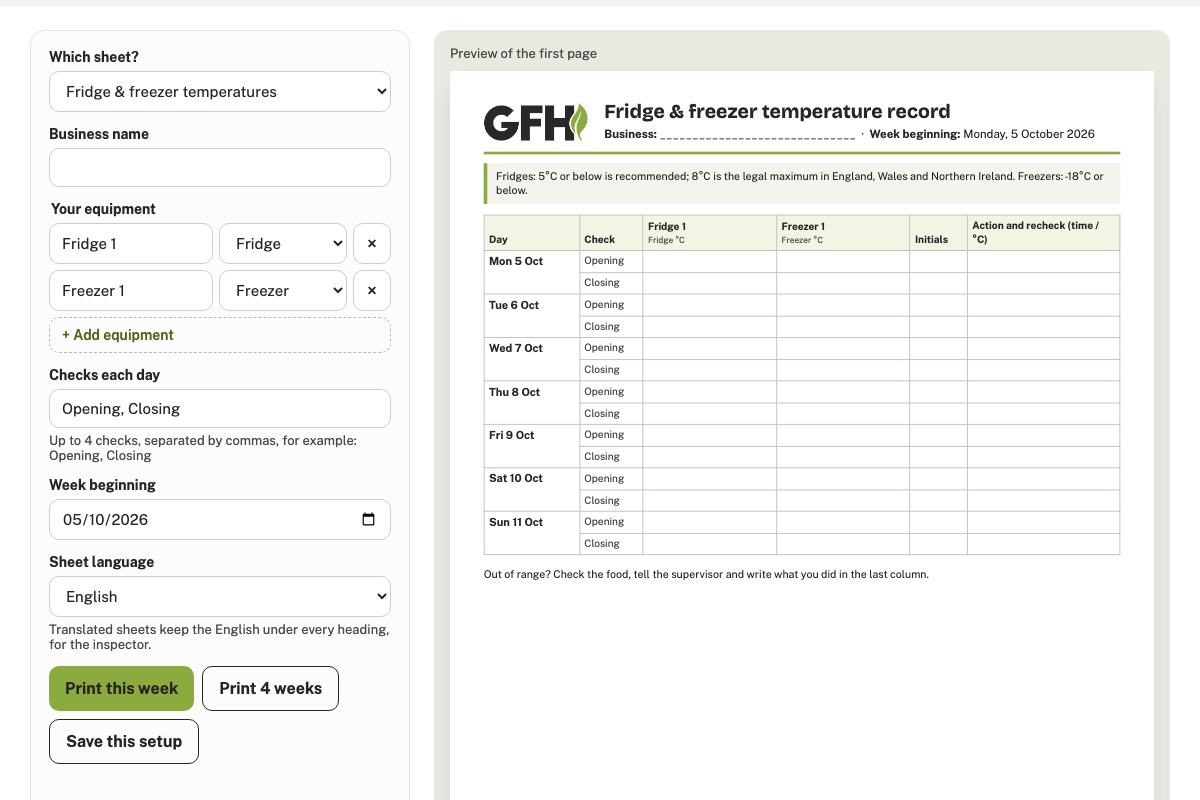
Most kitchens know they should be writing down fridge temperatures and cleaning, but the sheets they use are often a photocopy of a photocopy, with the wrong fridges on them and nowhere to write what happened when something went wrong. The record sheet maker fixes that. It is free, it takes a couple of minutes to set up, and the sheets come out with your kitchen’s own details already printed on them.
Why kitchens keep these records
Food law requires every food business to put in place, and keep to, food safety procedures based on HACCP principles, and to keep records that match the size of the business. For most small kitchens that means a system such as the FSA’s Safer Food, Better Business, or CookSafe in Scotland, plus simple daily records that show the checks were actually done.
When an environmental health officer inspects, the records are how you show that your fridges are cold enough, your hot food is hot enough and your cleaning gets done. A sheet that is filled in properly, every day, with a note of what you did when a reading was wrong, is worth far more than a perfect plan in a folder.
What the tool makes
- Fridge and freezer temperature record. One column for each of your fridges and freezers, up to four checks a day (for example opening and closing), with space for initials and for what you did if a reading was out of range. The targets are printed on the sheet: chilled food must be kept at 8°C or below by law in England, Wales and Northern Ireland, and 5°C or below is the recommended setting; freezers -18°C or below.
- Hot-holding log. A column for each bain-marie, hot cupboard or display, with your own check times. Hot food should be held at 63°C or above, checked in the centre with a clean, disinfected probe.
- Kitchen cleaning rota. Starts with the jobs on our free cleaning rota (work surfaces, boards and utensils, sinks, fridges, floors, cloths, bins, walls and high areas), each with when and how to clean it. Change them, add your own, and initial each day of the week.
- Goods-in and delivery log. Supplier, product and batch, temperature, the checks you made and whether you accepted or rejected the delivery, with your own acceptance limits at the top.
How to use it
- Open the record sheet maker and choose a sheet.
- Type in your business name and your equipment, check times or cleaning jobs. The preview updates as you type.
- Pick the week and the language for the sheet.
- Press Download this week (PDF) or Download 4 weeks (PDF), then print the PDF. Downloading and saving need a free account, which takes about 20 seconds; your setup is kept while you sign up.
- Save the setup, and next month’s sheets are one click away.
Sheets in your team’s language
Many UK kitchens have staff whose first language is not English. Records only work if the person filling them in understands them, so the sheets print in any of 15 languages: English, Welsh, Polish, Romanian, Spanish, Portuguese, French, German, Russian, Ukrainian, Chinese, Hindi, Bengali, Urdu and Arabic. On translated sheets the English stays under every heading, so an inspector can read the record too.
Tips for filling them in
- Write the reading you actually see, not the target. A sheet full of identical 3°C readings looks filled in after the event.
- If a reading is out of range, check the food, tell the supervisor and write what you did and when you rechecked. That last column is what shows your system works.
- Fill the sheet in at the time of the check, never in advance.
- Have a manager look over the week and sign the bottom of the sheet.
- Keep completed sheets with your other food safety records, in order, where you can find them during an inspection.
Paper or app?
Paper works, and many kitchens prefer it. If you would rather not chase sheets, the Good Food Hygiene app keeps the same records on a phone or tablet, reminds staff when a check is due and exports everything for an inspection. Every sheet has a link and QR code to the app, in the sheet’s language.
Make your record sheets now
Free, in 15 languages, with your own equipment on them.
Open the record sheet makerRelated free downloads
Free to download and print with a free account. See all our free posters and record sheets.