

Your basket
Cross-Contamination in the Kitchen, Explained
Cross-contamination is when bacteria spread from one food, surface or piece of equipment to another, most dangerously from raw meat to food that won’t be cooked again. Allergens spread the same way. You stop it by keeping raw and ready-to-eat food apart, cleaning and disinfecting in two stages, and washing your hands between jobs.

How it happens
GOV.UK defines it simply: “Cross-contamination is when bacteria is spread between food, surfaces or equipment.” The usual routes are hands, chopping boards, knives, cloths, and machines such as slicers. Bacteria on raw meat are killed by cooking, but the salad, the sandwich or the cooked ham they land on won’t be cooked again.
Food safety guidance names three kinds of hazard: microbiological (bacteria and viruses), chemical (“including cleaning chemicals, allergens”) and physical (“objects getting into food”). Cross-contamination can carry any of them.
Keep raw and ready-to-eat apart
The FSA’s E. coli O157 guidance says: “Businesses must ensure that work areas, surfaces and equipment used for raw and ready-to-eat food are adequately separated.” This is FSA guidance rather than law, and it applies in England, Wales and Northern Ireland; Food Standards Scotland has its own version. Separate areas and equipment are best; sharing a surface and cleaning between uses is the option that “carries the most risk”.
- Store raw food below ready-to-eat food in the fridge.
- Use separate boards, knives and utensils.
- Complex equipment such as slicers, mincers and vacuum packers “shouldn’t be used for both raw and ready-to-eat food during a normal business day”.
Clean, then disinfect
Disinfection “must always be carried out as a two-stage process”: first clean with detergent to remove dirt and grease, then disinfect. Use a disinfectant that meets “BS EN 1276:2009 or BS EN 13697:2001 or an equivalent standard”.
Cloths need care too. “Steeping dirty cloths in bleach is not considered an effective measure”.
Colour coding
Colour-coded boards and utensils aren’t a legal requirement, but the guidance strongly recommends colour coding, and says it becomes essential where you can’t heat-disinfect or put equipment through a dishwasher. Colour-coded cloths are good practice.
Hands, gloves and gel
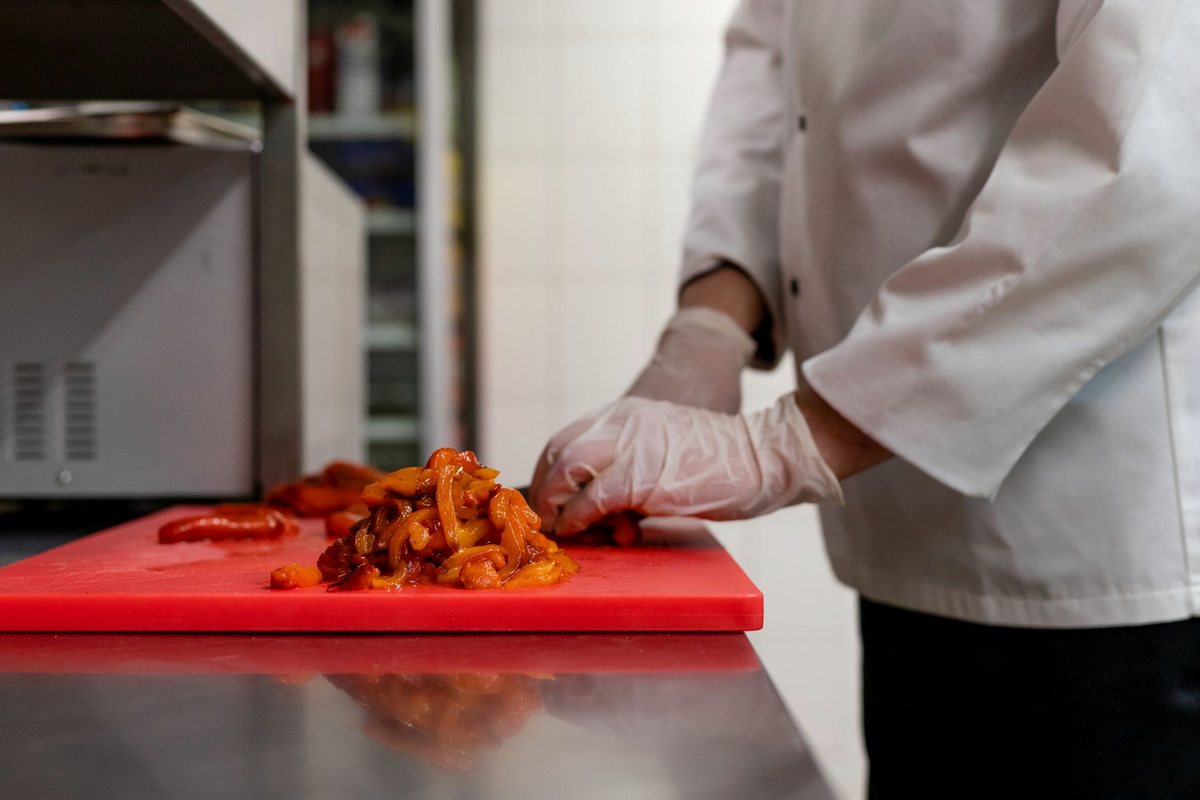
Hands can carry bacteria between jobs. The guidance says hand gels “are not to be used as a replacement for handwashing”, and gloves “are not a substitute for effective handwashing”. Wash your hands between raw and ready-to-eat work.

Allergens spread the same way
The FSA says: “You must prevent allergen cross-contamination.” That means cleaning utensils before each use, “washing hands thoroughly between preparing dishes with and without certain allergens”, storing ingredients in closed, labelled containers, and watching shared things like frying oil. If you can’t avoid cross-contact, tell customers you can’t provide an allergen-free dish. Our list of the 14 major allergens is a good place to start.
Stop cross-contamination before it starts
Food Safety & Hygiene for Catering covers separation, two-stage cleaning, colour coding and allergens, with practice questions after every lesson. Try it free.
Try the free practice course →Frequently asked questions
Are colour-coded chopping boards a legal requirement?
No, but FSA guidance strongly recommends colour coding, and says it becomes essential where you can’t heat-disinfect or dishwash equipment.
Is cleaning the board between raw and ready-to-eat food enough?
It’s allowed for simple equipment, but it’s the riskiest option. For complex equipment like slicers, the guidance says don’t use the same machine for both in a normal business day.
Does antibacterial spray on its own do the job?
Disinfection must be a two-stage process: clean with detergent first, then disinfect with a product that meets BS EN 1276 or BS EN 13697.
Free downloads for this topic
Free to download and print with a free account. See all our free posters and record sheets.
Sources
- GOV.UK: Food hygiene for your business, cross-contamination
- Food Standards Agency: E. coli O157 control of cross-contamination
- Food Standards Agency: E. coli O157 cross-contamination guidance (PDF)
- Food Standards Agency: Allergen guidance for food businesses
- GOV.UK: Food safety management systems
- Food Standards Scotland: E. coli O157 control of cross-contamination